1. Executive summary
Mooring-chain and anchoring operations sit at the intersection of safety, uptime, compliance, and environmental stewardship. Yet many blue-economy operators still work with fragmented inspections, brittle integrations, manual reporting, and one-off automation pilots that do not scale.
MediSea's thesis is that the next leap in maritime automation will not come from a single robot or model. It will come from a governed orchestration layer that combines modular hardware, edge intelligence, digital twins, human oversight, and audit-ready AI.
This whitepaper translates that thesis into a practical deployment model. It synthesises MediSea's public website positioning with the governance architecture and capability direction described in the client-supplied VIGIL proposal and partner profile. The result is a market-facing narrative for trustworthy, governance-ready AI-powered modular robotics in the blue economy.
2. The operational problem: intelligence without governance is not deployment-ready
Mooring systems fail slowly, expensively, and sometimes invisibly. Wear, corrosion, abnormal loading, weather-driven stress, and deferred maintenance unfold across distributed assets, while the underlying evidence is often scattered across maintenance logs, telemetry streams, spreadsheets, contractor reports, and point solutions.
That means operators need more than better sensing. They need an orchestration layer that can interpret signals, route work, recommend actions, and document the full chain of reasoning without crossing safety or compliance boundaries.
Why conventional AI can introduce new risk
- Context drift across long tasks can quietly corrupt priorities and recommendations.
- Hallucinated actions or guessed tool calls can create unsafe commands or incorrect records.
- Opaque decision paths make it hard for operators, auditors, and customers to understand why a recommendation was made.
- Multi-agent coordination can become unstable when several agents act across partial, delayed, or inconsistent data.
- Human oversight can degrade into rubber-stamping unless escalation thresholds and explanations are explicit.
| Operational risk | Governance response | Why it matters |
|---|---|---|
| Unsafe or guessed actions | Tool contracts, sandbox-first execution, least-privilege permissions, rollback hooks. | The system can recommend work without getting uncontrolled authority over critical actions. |
| Broken continuity across long maintenance workflows | Managed memory, provenance, retention rules, traceable state changes. | Long sequences remain coherent and reviewable instead of quietly drifting off course. |
| Opaque recommendations | Structured reasoning traces and evidence-linked logs. | Operators can challenge, approve, or override with context. |
| Coordination failures across assets and teams | Runtime monitoring, safety envelopes, escalation rules. | Fleet-level orchestration stays stable under uncertainty. |
| Compliance and customer-trust friction | Policy packs, audit packs, documented controls, human checkpoints. | The pilot can scale because its governance is reusable and inspectable. |
3. The MediSea stack: modular automation needs a trust layer
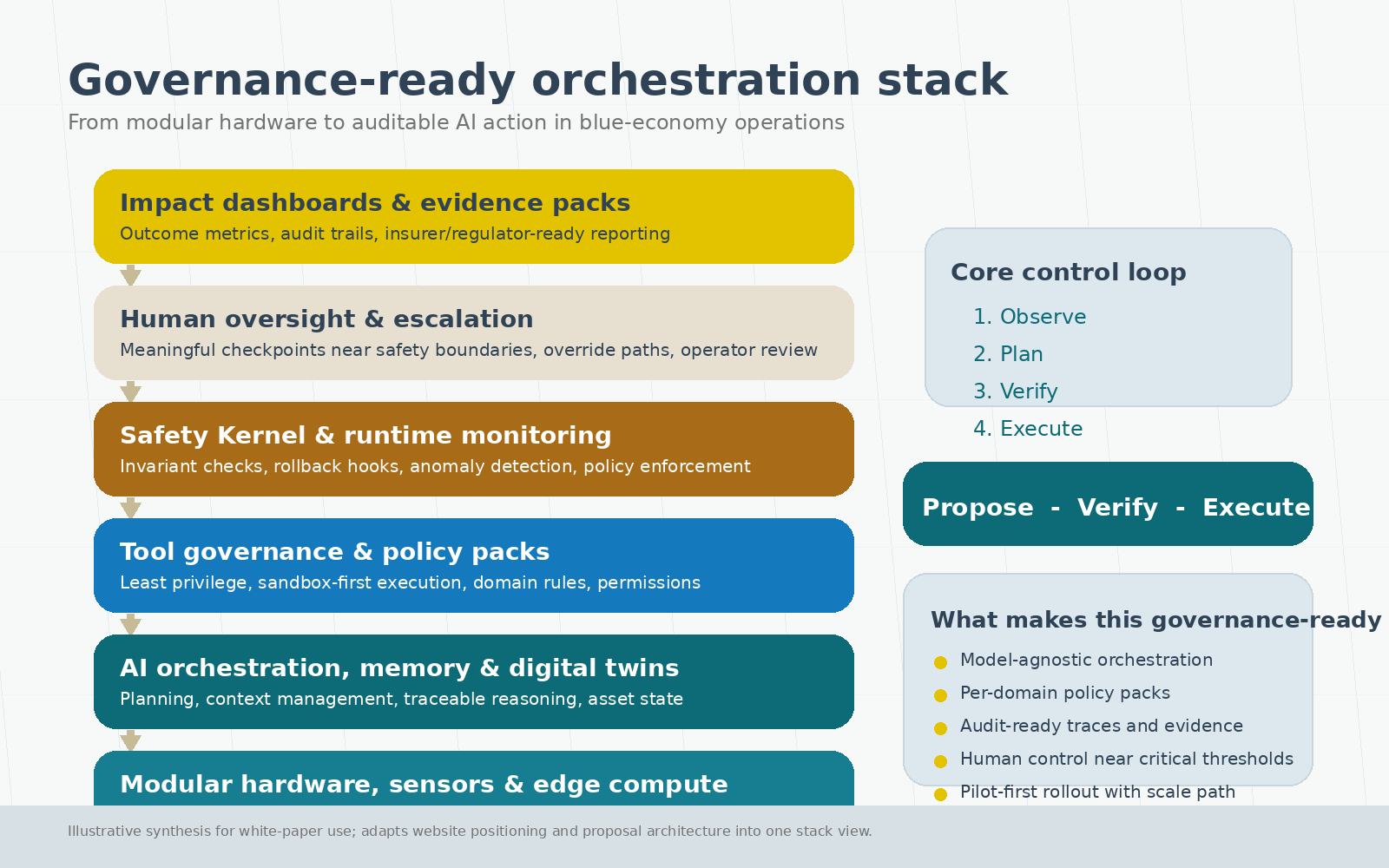
The VIGIL proposal is useful because it frames trust as an independent layer rather than an afterthought. In that architecture, the model can propose a plan, but a separate governance layer verifies permissions, safety rules, evidence requirements, and rollback conditions before action is allowed.
For MediSea, that idea translates naturally into blue-economy automation: modular hardware and partner systems at the bottom, orchestration and digital twins in the middle, and a governance and evidence layer on top. The robot is only one part of the system. The trust boundary sits in the orchestration logic that decides what may happen, under which rules, and with what trace.
4. One governed core, many blue-economy lanes
MediSea's website already points to multiple blue-economy sectors. The whitepaper opportunity is to explain that these are not separate products held together by branding. They are variations on the same governed orchestration model: shared core, sector-specific rules, modular hardware choices, and different evidence expectations.
| Operational lane | Illustrative use case | Value created | Governance emphasis |
|---|---|---|---|
| Offshore oil and gas | AI-assisted inspection and predictive maintenance for FPSOFPSOFloating Production Storage and Offloading vessel: an offshore oil and gas platform that extracts, stores and offloads hydrocarbons. One of the mooring-chain asset classes MediSea targets. mooring chains and critical assets. | Lower exposure, earlier anomaly detection, better service continuity. | Strict permissions, incident escalation, evidence for critical maintenance actions. |
| Renewable energy | Monitoring for offshore wind-farm and floating-solar mooring systems. | More resilient renewable operations and cleaner maintenance planning. | Safety-aware alerting, policy rules for weather and operational thresholds. |
| Marine transport | Inspection logging and anchoring-system health for ports, cargo vessels, and tankers. | Faster turnaround with clearer records and service prioritisation. | Audit-ready traceability and explainable recommendations. |
| Aquaculture | Data-driven mooring reliability for fish farms and hatcheries. | Protection of stock, habitats, and productivity. | Environmental constraints, operator checkpoints, regulatory recordkeeping. |
| Research and conservation | Low-impact monitoring for oceanographic platforms and protected marine areas. | Data integrity, ecological stewardship, long-term observability. | Access controls, evidence preservation, transparent governance rules. |
5. The 5 Ps are not branding alone; they are design constraints
MediSea's website positions the company around People, Planet, Prosperity, Profit, and Partnership. For a credible whitepaper, the 5 Ps should be described as an operating discipline that changes how the system is designed, deployed, and governed.
| Pillar | Design question | What it means in practice |
|---|---|---|
| People | How does the system keep humans meaningfully in control? | Explainable recommendations, override paths, safer work, and training-friendly workflows instead of black-box automation. |
| Planet | Does automation reduce environmental burden as well as operational friction? | Low-impact operations, smarter maintenance timing, efficient compute, and environmental stewardship in day-to-day decisions. |
| Prosperity | Who gains access to governed automation? | SME-friendly pilots, broader access for coastal communities, and shared value rather than innovation locked inside bespoke projects. |
| Profit | Can the model support resilient, outcome-based economics? | Transparent service models, modular upgrades, and a path from pilot spend to repeatable return. |
| Partnership | Can the system interoperate across partners, tools, and sectors? | Open integration logic, reusable policy packs, and a stronger ecosystem around AI, robotics, and governance services. |
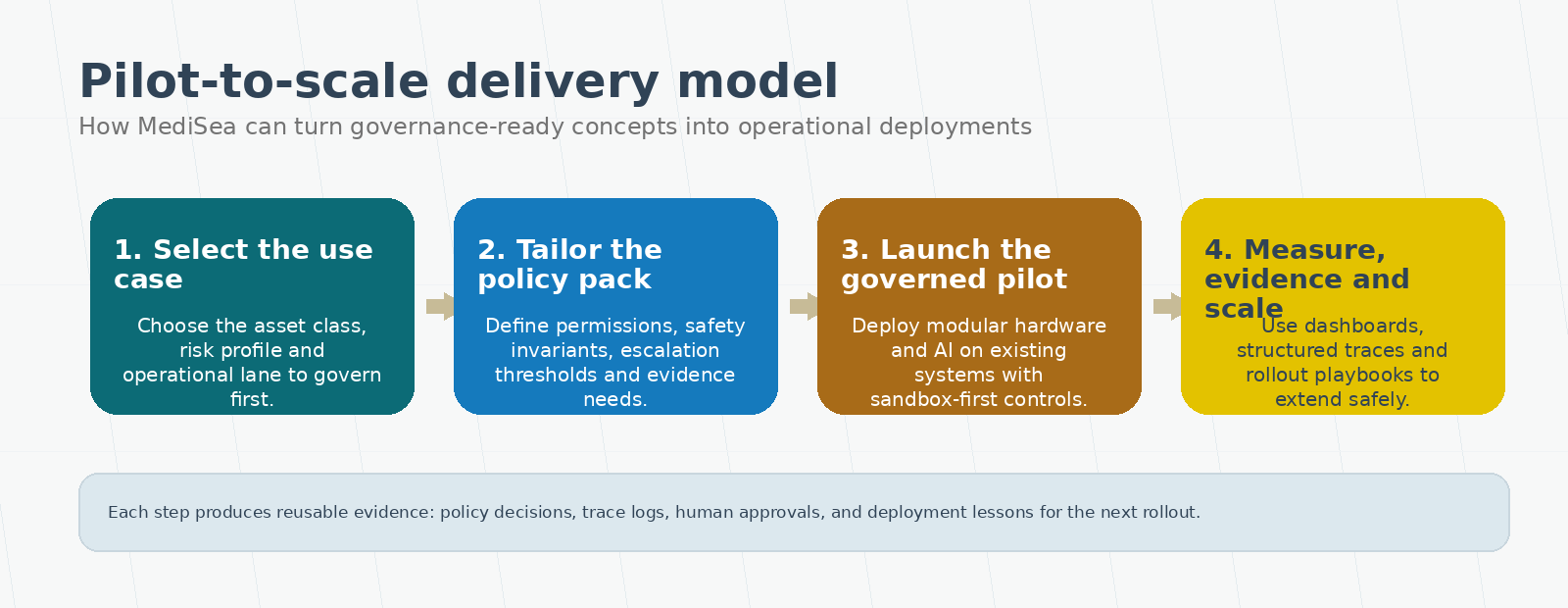
6. From pilot to scale: a repeatable delivery model
The website promise of launching in weeks becomes more credible when it is paired with a governance story. Speed comes from modularity and reuse; trust comes from policy packs, sandboxes, human checkpoints, and evidence that accumulates with every rollout.
What should ship with the governed core
- A pluggable orchestration core that can integrate existing AI services and partner modules.
- Managed memory and context controls for long-running tasks and asset histories.
- A tool-governance layer with contracts, permission scopes, and sandbox-first execution.
- A Safety Kernel for invariants, runtime checks, escalation rules, and rollback hooks.
- Structured traces and exportable evidence for customers, regulators, insurers, and internal review.
7. Why MediSea can tell this story credibly
The supplied partner profile describes MediSea as bringing expertise in trustworthy AI, multi-agent systems, knowledge integration, and explainable AI for enterprise and industrial applications. It also points to prior work in AI advisor development, bio-inspired knowledge integration, large-scale multi-agent simulation, and explainable assistant systems. See our projects and publications pages for the supporting evidence.
That matters because this whitepaper is not only about maritime hardware. It is about governed orchestration: how AI systems reason, how they use tools, how they remain auditable, and how they can be deployed responsibly in regulated or safety-sensitive environments.
| Capability base | Why it strengthens the whitepaper |
|---|---|
| Trustworthy AI and multi-agent systems | Supports the move from standalone tools to governed orchestration across assets, modules, and operators. |
| Knowledge integration and explainability | Strengthens the claim that recommendations can be reasoned about, reviewed, and documented. |
| EU and research-linked experience | Digital4Business, MSCA, ERC, and FP7 references add depth beyond a purely marketing-led narrative. |
| Training and partner enablement | Helps position MediSea as an adoption partner, not only as a technology vendor. |
8. Conclusion
A strong MediSea whitepaper should make one point clearly: trustworthy automation in the blue economy is not just about putting AI on a vessel or a robot on a chain. It is about governing the full orchestration layer so that recommendations, tool use, human approvals, and evidence all move together.
That is what makes the story commercially credible. Operators buy safer uptime, clearer accountability, faster pilots, and a path to scale. They do not buy raw model capability. By combining modular automation with governed AI orchestration and the 5 Ps framework, MediSea can position itself as a partner for deployment-ready impact rather than experimentation alone.
Source basis and transparency
This document was prepared from three source bases:
- MediSea Robotics public website messaging, including the homepage positioning and the whitepaper route.
- The client-supplied VIGIL proposal, used here as an architectural and capability reference.
- The client-supplied MediSea partner profile, used for expertise, prior-project context, and organisational fit.